
Hi friends,
Hope you enjoyed the (hopefully) long weekend! I desperately need some lake time.
In today’s issue:
1. PlayStation and the demise of physical media
2. Trump accounts have launched
3. On my radar

PlayStation and the demise of physical media
Last week, Sony’s PlayStation announced it will end physical game disc production starting in January 2028, meaning new games will only be available in digital formats.
This change is a “natural direction for Sony Interactive Entertainment to adapt to consumer trends as the general preference for digital media significantly outpaces physical discs,” the announcement post reads.
And there’s no doubt that more gamers buy digital versions of games than physical: about 80% of its full game unit sales are digital, according to Sony’s financial disclosures.
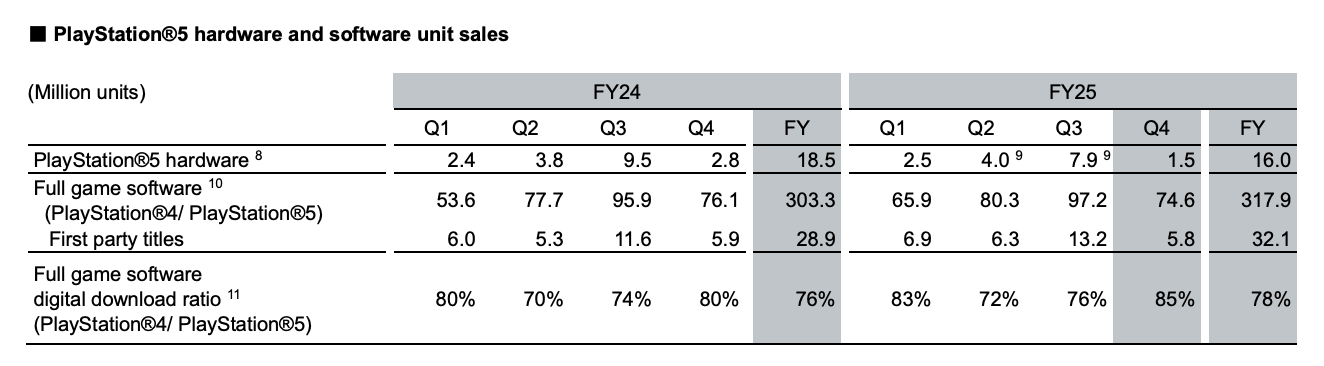
It’s also much better for Sony’s bottom line, as it greatly reduces the cost of producing, storing, and shipping the physical media.
But discontinuing physical discs marks a seemingly unwelcome change not just for gamers, but for the larger gaming economy.
I don’t game—aside from the Sims—but my husband does, and while he buys plenty of digital versions of games, he also collects some physicals. You likely know some of the perks: Not only can he buy the physical games used at a discount, but he can also trade them with other people, or let a friend borrow one. When you only have the digital version, you legally cannot do that.
The announced change also affects local, independent retailers. My husband loves to go to Videogamesnewyork, an old school video game store where part of the fun is perusing all of the old games they have stocked to see if there are any unicorns in there. Of course they sell hardware and other goods, but reselling used games is a big part of the ecosystem.
It brings people like my husband to the store; he can resell his old games or trade them in for something else. It’s much harder to build that irl community around digital goods (though possible, more on that below), especially because you cannot resell or trade e-games.
And there is also the potential that gamers may not be able to play the games they already own on new consoles like the PS6 going forward. Instead, you may have to buy them again digitally for the updated console.
Physical and digital media do not have the same consumer protections
Sony’s move is part of a much bigger shift we have been experiencing for years—even decades, given Spotify just turned 20—of moving away from physical media to digital. And that is a move with real consequences for consumers, even though many of us may not realize it.
It turns all of us into lessees, rather than owners. And that means we have fewer consumer rights while still paying ownership prices.
Blame copyright law. When you buy physical media, you literally buy the physical copy of it. And under the Copyright Act’s first sale doctrine, you are free to sell your physical media, lend it out, and give it away. It is why we can sell old DVDs on eBay and donate old books to the library.
But with digital goods, you are basically buying a license to use the book, movie, or whatever it is. There is no digital first sale doctrine, and licensing agreements impose use restrictions on digital content. You cannot resell it, and sometimes you are even limited to how many times you can download it. You see that a lot with music.
In fact, if you want to sell your digital media files, you would need to sell the entire device that the media is dowloaded onto, due to a 2013 court ruling.
This creates consumer lock-in and decreases competition among media companies: If you get tired of your PlayStation and want to try out XBox, you can sell your console and games and not be out all of your money. But with digital-only games, the potential financial cost is greater, locking you into the PlayStation ecosystem.
You may wonder why libraries limit the number of copies of ebooks or audiobooks they lend at a time. It’s because not only do book publishers charge libraries more for digital copies, but also because unlike with physical books—which theoretically can be kept in circulation indefinitely after they are purchased—the ebook and audiobook licenses need to be regularly renewed, often annually or every few years.
There have also been plenty of instances of services removing the digital goods people have purchased, whether books from your e-library, or movies or TV shows. Companies have also edited or retracted digital content that consumers “own.”
In fact, Sony just announced that U.K. customers wouldn’t be able to view hundreds of movies, even if they “bought” them. And the company is also discontinuing its digital stores for some older consoles completely, a good reminder that it can do that to any console it wants going forward.
“Starting in 2028, every PlayStation game comes with an expiry date; as soon as the PS5’s digital store shuts down, a huge swath of games will simply become inaccessible,” Andrew Webster writes for The Verge.
One of the recognized justifications for physical media’s first sale doctrine is actually media preservation. When the copyright owner no longer sells the works, people who bought a copy of it can keep it alive. But with digital-only content, that is much harder (we might say the internet is forever…but it’s not).1
Full Steam ahead
It’s not a surprise that games are moving this way. In some ways, the fact that many of them can still be physically purchased is anachronistic—most retailers long ago stopped selling physical movies, music, and TV shows; if you are lucky, you can buy the most popular of each locally.
The popularity of Steam, an online storefront and gaming platform, shows the benefits of a digital-first marketplace. Developers can upload their games easily and inexpensively, and anyone on the platform can find it and play it. Millions of people use Steam, and they have created a flourishing online community.
Digital-only is convenient, and there is no question that that is most consumers’ preference for seemingly all of their media, when they have the choice.
But choice is the key word. With much of the rest of our media, we at least have the option to buy physical copies if we want. I have an e-reader and frequent the library, but I still prefer owning physical copies of books. And there’s been a big vinyl resurgence in recent years, as consumers have desired building physical collections of the music they love. Sony appears to be taking away that option completely.

530A—AKA Trump—accounts are live
Good news for everyone waiting with bated breath: Trump accounts are now live, and if it makes sense for your financial situation, you can start funding them.
The accounts—officially named 530A accounts—are federally sponsored investment accounts for American children under 18. Parents/guardians, family members, and employers can contribute to them and the funds are invested in U.S. index funds, much like a 401(k) or other retirement account you are already familiar with.
Your investments are tax deferred, so you don’t pay taxes on any growth each year. But your kid will pay taxes when they withdraw the funds, like a tax-deferred retirement account (though there are slightly different rules depending on the source of the contribution).
Speaking of which, when your kid turns 18, the account works much like a traditional IRA. If you pull money out for a non-qualified reason before age 59½, you will pay income taxes plus a 10% penalty.
Qualified reasons for using the funds—meaning you do not pay a 10% penalty—include higher education expenses, a first-time home purchase up to $10,000, or the birth or adoption of a child. And of course, the rest can be used as a jumpstart on retirement savings.
If you’re like, wait, can’t you also take a penalty-free disbursement from your retirement account for those same reasons? You are basically correct. But the difference between funding a Trump account and a custodial traditional or Roth IRA for your kid is that the latter can only be funded with earned income. So assuming your newborn doesn’t have a job, you cannot contribute to a retirement account for them until they do.
The thinking with the Trump account is that your kid could have, say, 15 or 16 more years of investment growth and compounding if you open a 530A account for them when they are born. If you’re making regular contributions, then they will have more socked away for those specific non-retirement reasons.
There are other account options, too. A 529 account is a state-run, tax-advantaged investment account for educational expenses. There’s no contribution limit, and your funds grow tax free; you pay no federal income tax on withdrawals that are used to pay for qualified education expenses like tuition and books. If you make a non-qualified withdrawal, you pay taxes and a 10% penalty.
And a custodial brokerage account—often known as UGMA or UTMA account—has no contribution limit or earned income requirement, plus no early withdrawal penalties. You can invest in whatever your broker offers, rather than the pre-set options for Trump accounts and 529s. But contributions are not tax-deductible and earnings are subject to federal and potentially state and local taxes. These accounts may also impact what financial aid your kid qualifies for if they go to college.
Other Trump account details
American citizens born during Trump’s second presidential term (start of 2025 to end of 2028) will receive $1,000 from tax payers if/when they open account, and there are some other children who qualify for seed money from other benefactors. But parents can open a 530A account for any child under 18.
Parents can contribute up to $5,000 per year (the $1,000 from the government doesn’t count), and employers can contribute up to $2,500 of that.
The default investment option for Trump accounts at launch is the State Street SPDR Portfolio S&P 500 ETF, a low-cost exchange-traded fund (it has an expense ratio of 0.02%, in line with what these should cost) that tracks the S&P 500.
For now, all funds will be invested in the default fund. In the weeks to come, “Treasury expects to make available functionality that will allow parents or guardians to choose how to allocate funds across the additional investment options,” the Treasury Department announced. That includes:
iShares Core S&P 500 ETF
Vanguard Total Stock Market ETF
State Street SPDR Portfolio S&P 1500 Composite Stock Market ETF
iShares Core S&P total U.S. Stock Market ETF
Once available, families will have to manually change their asset allocation if they want to.
Lindsey Stanberry and I have been working with Babylist on a library of content about Trump accounts, 529s, and other financial tools for kids and families for the past six months. We’ve spoken with quite a few financial advisors, tax experts, and other professionals about the accounts and their best use cases, and we’ve gone deep in the weeds reading Treasury and IRS guidance for them.
The advice that we’ve been given over and over and over again is that if you qualify for the $1,000, then great, open an account and collect it. If your employer offers a matching contribution, that’s another good reason to open an account. But otherwise, the equation isn’t as straight forward.
You can think of all of the accounts as different tools in your toolbox. What makes the most sense for your family? Do you have the extra funds to contribute, or could family members?

On my radar
Books: I started Audition by Kate Kitamura this weekend and the beginning really hooked me!
Ticks: They’re scary!
TikTok: Here’s me talking about the job market.
 Tiktok failed to load.
Enable 3rd party cookies or use another browser
That’s it for now. See ya soon,
A
P.S. Thanks Christopher Skinner for the illustrations!
All of this is interesting to think about in the context of a company like Netflix. It started by buying DVDs and then renting them out to consumers—something only possible at that scale because of the the first sale doctrine. But now, with most of its titles being digital only, it limits how consumers can interact with the content, even blocking screenshots or screen recordings so it’s harder to legally share clips of show and movies.
I appreciate the info on the 530As. In the tax office this spring, we had to ask people if they wanted to opt in and there was hardly any real guidance on what they were. The $1,000 is a nice carrot but other than that I agree that there are other options. I’d like to see a little more flexibility on what these accounts can be used for.
You have put your finger on the exact legal hinge, which is the first-sale doctrine. Once you buy a physical copy of something, the seller's control over that copy ends and you can resell it, lend it, or leave it to your kids. A digital purchase is not a purchase at all — the terms almost always grant you a revocable, non-transferable license, and the word "buy" on the button does not change what the agreement says underneath it. Same button, same price, and one of them you own.